
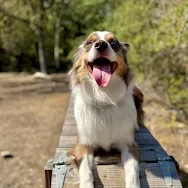
When Kampbell brought Cash, her Australian Shepherd, to All Around K9 Training, she wasn’t asking us to teach him tricks. She was asking us to give her back her dog. Cash’s reactivity and inconsistent listening had made public outings stressful — the kind of stress that quietly shrinks a dog owner’s world until the leash barely comes off the hook anymore. Four weeks of structured reactive dog training in San Antonio later, the picture had changed completely. This is Cash’s story.
Meet Cash
Cash is an Australian Shepherd, which tells you a lot before we get into specifics. Aussies are smart, driven, and built to work. When that drive doesn’t have a job, it tends to find one — and the job a reactive Aussie picks for himself is usually scanning the environment, reacting to triggers, and pulling his owner around the world like a one-dog security detail. That was Cash.
Kampbell didn’t come to us with vague concerns. She came to us with specifics. Cash’s listening was inconsistent — fine in the house, fine in the backyard, falling apart the second a real distraction entered the picture. His reactivity made walks tense. Public outings — patios, parks, the kind of San Antonio outdoor culture every dog owner here wants to be part of — had become more work than they were worth. She wasn’t going to give up on the dog. She wasn’t going to give up on the lifestyle either. But the gap between what she had and what she wanted was widening.
This is the reality of living with a reactive dog. The reactivity itself is the headline issue, but the slow, steady cost is the world your life shrinks to. You stop walking the routes you used to walk. You stop inviting people over. You start scheduling around the dog’s triggers instead of building a life that includes the dog. Kampbell’s goal — said clearly from the first call — was to get back to a place where outings were possible again. Better control. Better focus. A dog who could exist in the world with her, not against it.
That goal — control and focus — is the right framing for reactive dog training. We’re not trying to “cure” reactivity in some absolute sense. We’re trying to build the skills, the relationship, and the systems that let the dog and the owner navigate the world successfully. That’s a different goal than pure obedience, and it requires a different kind of program.
The Problem: Reactivity Is the Hardest Behavior to Fix on Your Own
If you’ve ever lived with a reactive dog in San Antonio, you already know the loop. You see the trigger before the dog does. You start managing — moving across the street, shortening the leash, stiffening up. The dog feels your tension and the trigger arrives at the same time. The reaction lands. You both come home stressed. Tomorrow you do it again, a little more carefully, with a little less hope.
Reactivity is the hardest behavior pattern to fix on your own for a few specific reasons. First, the timing window is razor-thin — the right intervention has to happen before the dog goes over threshold, and most owners don’t read their dog’s body language quickly enough to catch that moment. Second, the owner’s own emotional state is part of the loop. A tense leash, a held breath, a stiffened posture — the dog reads all of it and the trigger lands harder. Third, every failed walk reinforces the pattern. The dog learns the behavior works, the owner learns to dread the next walk, and the loop entrenches.
This is why YouTube videos and weekly group classes don’t fix reactivity. The dog needs hundreds of carefully calibrated reps with a handler who can read body language in real time, intervene before threshold, and reinforce the right choice the instant the dog makes it. That’s not a once-a-week-for-an-hour skill. That’s a daily, immersive, multi-week project. And the owner needs the same training the dog gets — because at the end of the program, the owner is the one running it.
If you’re searching for reactive dog training in San Antonio, the program you want is one that takes the dog through structured exposure under controlled pressure, builds the obedience foundation that gives the dog something to do other than react, and then teaches you — the owner — how to handle every piece of it on your own. Anything less is going to leave you in the same loop you started in.
The other thing worth saying directly: reactive dog training in San Antonio isn’t a quick fix. It’s not a two-week program. It’s not a tune-up. It’s serious work that compresses months of behavioral rewiring into a few weeks of immersive training. Cash’s case called for the full 4-week program — and that was the right call.
Why Kampbell Chose All Around K9 Training
Kampbell did her research. Reactive dog training is the area of dog training where the difference between a great trainer and an average trainer is the most consequential — a wrong approach can entrench reactivity instead of fixing it. She wasn’t going to roll the dice on a program that hadn’t worked with dogs like Cash before.
What stood out about All Around K9 Training for her was a few things. First, our willingness to do an honest evaluation of Cash before recommending a program. Reactivity has a lot of flavors — fear-based, frustration-based, prey-driven, mixed — and the program has to match the dog’s specific profile. Second, our integration of structured training and owner coaching. We don’t just hand back a dog and a manual. We hand back a dog and a trained handler. Third, our experience specifically with high-drive working breeds like Aussies. Different breed profiles call for different calibrations, and Aussies need a particular blend of mental work and impulse control.
If you’re searching for a dog trainer in San Antonio TX for a reactive dog, the qualifying questions are non-negotiable. Has the trainer worked with dogs of similar breed and reactivity profile? Can they explain their approach to threshold, exposure, and counter-conditioning? Are they running an owner-coaching component or just training the dog? Kampbell asked. We answered. That’s how the partnership started.
Inside the 4-Week Reactive Dog Training Program
Here’s what Cash’s four weeks actually looked like.
Week One: Foundation Without the Triggers
Reactive dogs need a foundation before they’re asked to do anything in the presence of triggers. The first week is mostly trigger-free obedience work. Marker system installed. Crate training as the structural piece that gives Cash an off switch. Foundation obedience — sit, down, place, recall — drilled in low-distraction environments until the timing was sharp and the cues were reliable. We’re building the toolkit Cash will need in week two and beyond, before we ever add real-world pressure.
Week Two: Threshold Work and the E-Collar
Week two is when we introduce the e-collar — properly conditioned, used as a low-level communication tool, not punishment. For a reactive dog, the e-collar is a game-changer because it gives the handler precise, calm, immediate communication at any distance. We started exposing Cash to triggers at distances well below threshold, marking and reinforcing the choice to stay focused, and gradually closing the distance as his thresholds expanded.
The discipline here is patience. Reactive dog training fails when handlers push too fast — when they close trigger distance before the dog is ready and trip the very pattern they’re trying to break. Done right, the dog has dozens of successful reps under threshold for every one rep at the threshold. The skill isn’t dramatic. The skill is consistent, calibrated, accumulated.
Week Three: Real-World Generalization
Week three takes the work into real San Antonio environments. Sidewalks with dogs walking by. Outdoor patios. Parking lots. The kinds of stimulus settings where Cash’s reactivity used to thrive. Each session is structured to keep him below threshold most of the time, with occasional carefully managed exposures to harder triggers as his coping skills expand.
Week Four: Owner Coaching and Handoff
The final week is where most reactive dog training programs cut corners and where ours doesn’t. Kampbell came in for hands-on coaching. She practiced reading Cash’s body language. She practiced the timing of the marker, the leash, the e-collar. She walked him in the same real-world environments where we’d been working him, with us coaching her in real time. She made mistakes and learned to correct them. By the time Cash went home, Kampbell wasn’t receiving a trained dog. She was the trained handler who could keep him that way.
The Transformation
The Cash who went home wasn’t the same dog who arrived. The reactivity wasn’t gone in some magical, absolute sense — that’s not what reactive dog training delivers, and any program that promises that is selling something it can’t deliver. What changed was Cash’s ability to focus on Kampbell instead of his triggers, his ability to choose engagement over reaction, and his ability to handle public environments without going over threshold.
Walks became walks again, not management exercises. Public outings became possible again. The lifestyle Kampbell had been slowly losing access to was back on the table. And — maybe just as important — Kampbell now had the tools to maintain the work for the rest of Cash’s life. She could read him. She could intervene before threshold. She could reinforce the right choices. The training was now a system she could run, not a one-time event.
The owner-coaching component is what makes the difference between a 4-week program that lasts and a 4-week program that fades. Cash’s results held because Kampbell could hold them. That’s the whole point.
What This Means for Other San Antonio Dog Owners
If you’re a San Antonio dog owner reading this and recognizing your own situation in Kampbell’s — a reactive dog, a shrinking world, public outings that feel impossible — Cash’s story isn’t an outlier. It’s a representative example of what reactive dog training can do when the program matches the dog and the owner is willing to put in the handoff work.
Reactivity is not a life sentence. It is, however, an expensive problem to leave alone. Every week that passes without structured intervention is a week the pattern gets more entrenched and the world gets a little smaller. If you’re searching for reactive dog training in San Antonio, the question isn’t whether it’s worth doing. The question is whether you do it now, when the patterns are still flexible, or in a year, when they’ve calcified further.
For dogs whose issues are less severe but still significant, our standard board and train in San Antonio may be the right fit. For owners who want to start with a lower-commitment evaluation, private lessons can serve as a starting point. The right program depends on the dog, the owner, and the goal — and we’ll help you figure out which one fits.
Frequently Asked Questions
How long does it take to train a reactive dog?
Genuine progress on reactivity typically takes a 3-4 week immersive program plus several months of consistent owner follow-through. There are no two-week miracle programs for reactivity — the rewiring takes time. Our 4-week program is built to deliver meaningful change in that window, with the owner-coaching component that makes the change durable.
How much does reactive dog training cost in San Antonio?
4-week reactive dog training programs in San Antonio generally fall in the $5,000-$7,500 range depending on the trainer’s experience and what’s included. We’re transparent about pricing on the consult call — no hidden fees, no surprise add-ons.
Will my reactive dog ever be “normal”?
“Normal” isn’t quite the right framing. What we deliver is a dog who can handle the world — who can walk past triggers without going over threshold, who chooses engagement with you over reaction, and who has the impulse control to navigate public settings successfully. That’s a dog you can live with, hike with, take on patios. The reactivity may always be in the dog’s makeup at some level — what changes is the dog’s ability to manage it.
Do you use e-collars on reactive dogs?
Yes — and properly conditioned, the e-collar is one of the most humane tools available for reactive dog training. It gives the handler precise, low-level communication at any distance, which means the dog can be off-leash safely and the corrections can be calmer than they’d be on a leash and prong. We walk every owner through how it works before we use it.
What kinds of reactivity do you work with?
Leash reactivity, dog-directed reactivity, stranger reactivity, frustration-based reactivity, and fear-based reactivity. Different profiles call for different approaches, which is why the evaluation up front matters so much.
Ready to Get Your World Back?
If your reactive dog has been slowly shrinking your life — fewer walks, fewer outings, more management — Cash’s story is a roadmap for what’s possible. Every reactive dog training program at All Around K9 Training starts with an honest evaluation and a conversation about your specific dog and goals. No pressure, no commitment until we’ve met your dog and agree we’re the right fit. Reach out and let’s talk about whether a 4-week program is the right next step.